What Is an HMO, and Is the Extra Yield Worth It?
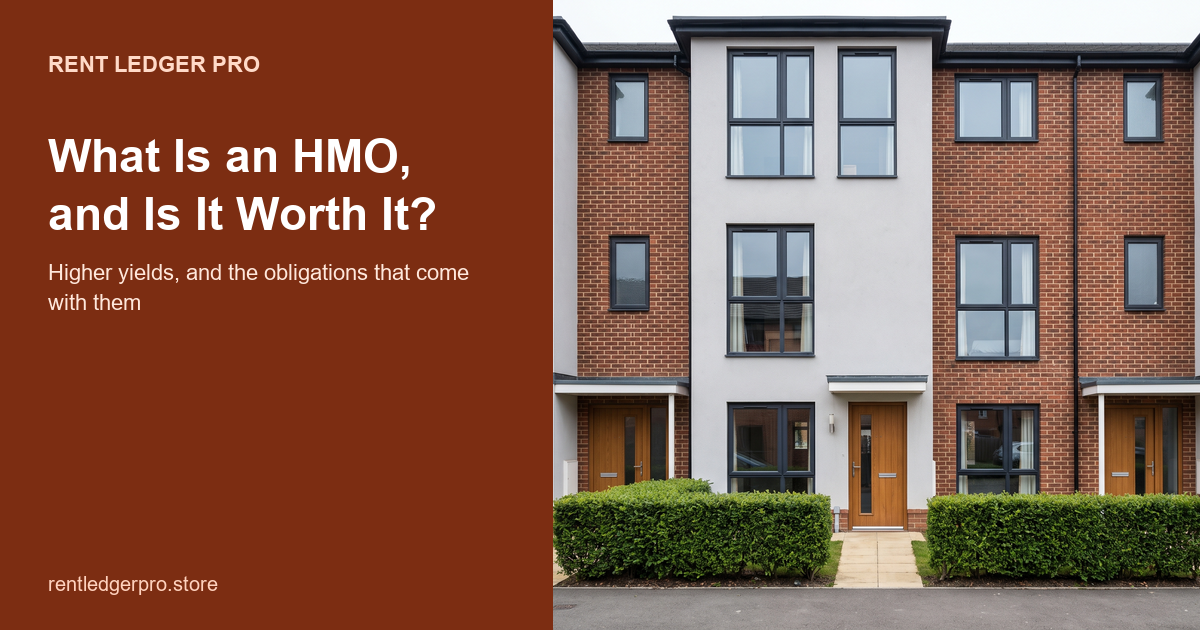
An HMO can produce roughly double the gross yield of the same property let to one household.
It can also produce roughly triple the work, a licence application, a longer list of safety obligations, and a bill for converting the property before a single tenant moves in.
Whether that trade is worth it is arithmetic, not opinion. Here is how to run it.
What counts as an HMO
A House in Multiple Occupation - broadly, a property let to several tenants who are not one household and who share facilities such as a kitchen or bathroom.
The common definition is three or more tenants forming more than one household. A couple and their children are one household. Three unrelated professionals sharing a kitchen are three.
The exact threshold, and whether a licence is required, varies by country and often by individual council or city. That variation is the single most important thing to check before buying.
The yield case
Take the 180,000 property used throughout this blog, let to one household at 1,400 a month.
| Single let | Four-bed HMO | |
|---|---|---|
| Monthly rent | 1,400 | 4 x 575 = 2,300 |
| Annual rent | 16,800 | 27,600 |
| Gross yield | 9.3% | 15.3% |
That is the number people repeat. Now the costs that only apply to the HMO.
The costs the yield figure leaves out
Bills are usually yours
Most room lets are advertised bills-included. Electricity, gas, water, broadband and often a cleaner for common areas. Realistically 250-450 a month on a four-bed - call it 4,200 a year.
Higher voids, counted per room
A single let is either occupied or not. An HMO has four independent tenancies, each turning over. A 10% void rate across four rooms is normal, and each changeover carries its own advertising and referencing.
Heavier wear
Four unrelated adults use a kitchen harder than one family. Budget 12-15% of rent for maintenance rather than 8%.
Licensing
Where required, an application fee running into hundreds or low thousands, renewable every few years, plus conditions you must meet to be granted it.
Conversion and compliance
Interlinked fire alarms, fire doors, emergency lighting, minimum room sizes, sometimes a second bathroom. 10,000-30,000 is a common range, and it is spent before any rent arrives.
Management
If you use an agent, HMO management typically costs 12-15% rather than 8-10%, because it is genuinely more work.
The honest comparison
| Annual | Single let | Four-bed HMO |
|---|---|---|
| Rent after voids | 15,960 | 24,840 |
| Bills | 0 | -4,200 |
| Management at 10% / 14% | -1,596 | -3,478 |
| Maintenance at 8% / 14% | -1,277 | -3,478 |
| Insurance and compliance | -780 | -1,600 |
| Licence, amortised | 0 | -400 |
| Net before mortgage | 12,307 | 11,684 |
On these assumptions the HMO produces slightly less than the single let, before you count the 10,000-30,000 conversion or the extra hours.
That is not an argument against HMOs. It is an argument against the 15.3% figure. Change the assumptions - cheaper property, higher room rents, self-managing, minimal conversion - and the HMO wins comfortably. The point is that it wins on those numbers, not on the gross yield.
When an HMO genuinely works
- The property is already compliant - buying an operating HMO with a licence in place removes the largest single cost
- Room rents are high relative to purchase price - university cities, areas with strong professional demand
- You self-manage and live nearby - the management premium is the second largest cost and you can remove it
- You have a maintenance contact you trust - four tenants generate four times the small problems
When it does not
- You are buying your first rental - see Buying Your First Rental Property and learn on a single let first
- You live far away and would pay full HMO management
- The council operates additional or selective licensing with restrictive conditions
- The conversion cost exceeds two years of the extra income
- You want a passive asset - an HMO is a small business, not a passive one
Before you buy one, check
- Whether a licence is needed at that exact address, and whether the council operates additional licensing
- Minimum room sizes - a room below the threshold cannot be let, and it may be the room the yield depended on
- Planning - some areas require planning permission to convert to an HMO, and some refuse it
- Fire safety requirements - the biggest conversion cost
- Mortgage availability - fewer lenders, often higher rates, and they will ask about licensing
- Insurance - standard landlord policies typically do not cover HMOs
Frequently asked questions
Do I need a licence for every HMO?
No. Mandatory licensing usually applies above a size threshold, but many councils operate additional or selective schemes that catch smaller properties. Check the specific address with the local authority.
Can I convert a normal house into an HMO?
Often, subject to planning, licensing, fire safety and room sizes. Cost and feasibility vary enormously - price it properly before you buy on the assumption you can.
Are HMO tenancies different?
Usually individual room agreements rather than one joint tenancy, which changes how liability, deposits and notice work. Do not reuse a single-let agreement without review.
How much more work is it, honestly?
Several times more. Four tenancies, four sets of referencing, four deposits, shared-area disputes, bills to manage, and a compliance regime with real penalties.
Run your own numbers, not the headline
Use the free Rental Yield & Cash Flow Calculator twice - once as a single let, once with HMO rent and realistic management, maintenance and void figures. Add bills as an annual cost. The gap between those two results is your real answer.
If you go ahead, the Rental Property Tracker handles up to twenty properties, so each room can be tracked as its own line with its own rent and arrears. $27 once.
General information for landlords, not legal, financial or tax advice. HMO definitions, licensing thresholds, minimum room sizes, planning rules and fire safety requirements differ substantially between countries and between individual local authorities, and change frequently. Figures are illustrative. Confirm the position for your specific address with the local authority and a qualified adviser before buying or converting.
-
Posted in
hmo, licensing, property investing, yield